Watch Winter olympic 2018 Short Track Speed Skating Live streaming online Link
Watch Winter olympic 2018 Short Track Speed Skating Live TV>>>>>
The 2018 Winter Olympics in PyeongChang, South Korea are right around the corner! That means it's time to watch sports you might not have seen in four years. To help you feel at least a little more informed—either to impress your friends or fake your way through a conversation with an actual expert—SI will be providing rookie's guides to each of the 15 sports. These will be published daily, Monday through Friday, from December 4-22. Your favorite speed skater Apollo Anton Ohno will not be competing in PyeongChang, but that doesn't mean the short track speed skating at the upcoming Games will be any less exciting or beautiful. The short track races put a premium on explosiveness and strategy, but the skaters' synchronized movements and long, smooth strides give the competition an element of elegance. Speed skating is the quintessential Winter Olympic sport—it's nearly impossible not to enjoy, but it's also highly unlikely that you'll watch any non-Olympic action. Here's everything you need to know about one of the easiest Winter Olympic sports to understand. (Spoiler alert: It's like track, but competitors don't run; they skate!)
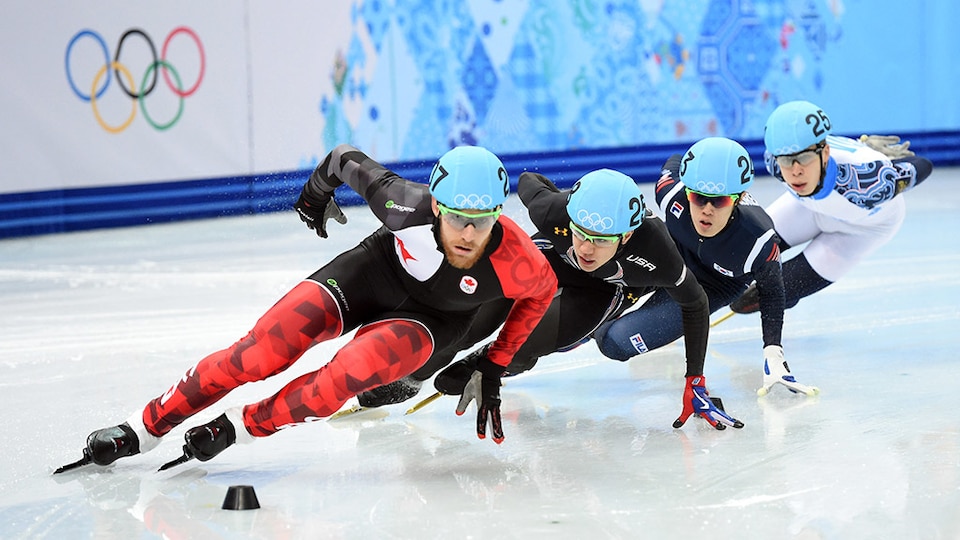
What is short track speed skating? Short track speed skating is an umbrella term that encompasses four men's and four women's races. Each race takes place on an oval track of ice that is 111.2 meters long, while the entire sheet of ice is 60 meters long and 30 meters wide. The simplest way to conceptualize short track speed skating—and there's really no reason to complicate things—is by thinking of it as a track and field race, but on ice. The one main difference between the short-distance track races and short track speed skating is that there are no lanes in the short track, so there is a bit of an advantage for those who start on the inside starting position. Skaters travel in a counterclockwise direction, which means only left turns are made, just as in NASCAR. What's the difference between short track speed skating and speed skating? A few things. The first and most obvious difference is the track size—the short track events are, as the name might suggest, contested on a significantly shorter track than the speed skating events. In true make-or-break fashion, competitors in speed skating events get just one timed run on the track per distance. Their performance in that one run determines their finish. On the other hand, short track competitors skate multiple times as they progress through multiple rounds before reaching the final. What are the different events? Both men and women compete in the 500m (4 1/2 laps), 1000m (9 laps) and 1500m (13 1/2 laps).The 500m (4 1/2 laps) is a dead-out sprint in which the start is crucial. The men's world record in this event is 39.937 seconds, set by American J.R. Celeski in 2012. The women's world record is 42.335 seconds, set by the United Kingdom's Elise Christie in 2016.The 1000m (9 laps) puts equal emphasis on sprinting capabilities and tactics. The men's world record in this event is 1:20.875, set by South Korea's Hwang Dae-Heon in 2016. The women's world record is 1:26.661, set by South Korea's Shim Suk-hee in 2012.Finally, there's the 1500m a grind that rewards stamina and strategy. The men's world record in this event is 2:07.943, set by the Netherlands' Sjinkie Knegt in 2016. The women's world record is 2:14.354, set by South Korea's Choi Min-jeong in 2016.In addition to the three distances that the men and women both compete in, the men participate in a 5000m four-man relay (45 total laps) and the women compete in a 3000m four-woman relay (27 total laps). The men's relay world record is 6:29.052, set by the U.S. in 2017, while the women's is 4:04.222, set by South Korea in 2016.When did short track speed skating become an Olympic event?
Short track made its Olympic debut in 1992 at Albertville, Canada, but only four events were contested there: the men's 1000m, the women's 500m, the men's 5000m relay and the women's 3000m relay. In 1994 the men's 500m and women's 1000m were added. The men's and women's 1500m were finally added in Salt Lake City in 2002. What are the rules? The guiding principle for short track speed skating is to cross the finish line first. It is, after all, a race. And while allowing skaters to tackle, block and trip their competitors would arguably make for a more entertaining spectacle, there are guidelines that prevent that sort of thing. The following actions will result in disqualification (per the International Skating Union, whose rules are used in the Olympics): Impeding: Pushing, blocking, tripping or otherwise causing an impediment for another skater. Off track: Skating outside the designated track. Assistance: Giving physical assistance to another skater. For example: Pushing a teammate from behind for an extra boost, or allowing a teammate to lean on another for stability around corners. Shooting the line or kicking out: Driving the foot in lead ahead to reach the finish faster, resulting in the lead foot lifting off the ice and creating a dangerous situation for others. Equipment: Not wearing the proper safety equipment, losing equipment during the race, or exposure of skin not on the face or neck. False Start: Leaving before the firing of the starter's pistol. On the second violation in the race, the offender on that start is disqualified. Did not finish: Usually due to injury, if the skater did not finish the race. Did not skate: If the skater did not go to the starting line. There is one more rule that's unique to the relays: Unlike track relays, where each competitor must run the same distance, teammates may pass the baton at any point during the race except for the last two laps, which must be completed by one person. This adds an element of strategy, as teams must decide when they feel it's best to switch to a new skater. What is the format of the competition? The format for the men's and women's 500m and 1000m are the same. The competitions begins with the first round, which features eight heats of four skaters each (total of 32 skaters). The top two finishers from each heat move on to the quarterfinals. In the quarterfinals, the 16 skaters who advance are divided into four heats of four skaters each. Again, the top two finishers (total of eight) advance to the semifinals. The semifinals consist of two heats of four skaters each (eight skaters); the top two finishers from both heats advance to the "A" final, while the bottom two go on to skate in the "B" final. The finishing order of the four skaters in the "A" final determine who gets the medals, while the "B" final determines who finishes fifth through eighth. The format for the 1500m is a little different—most notably, there's no quarterfinal round because the heats are larger, and there are 36 competitors rather than 32. All 36 skate in the first round, where they're separated into six heats of six skaters each. The top three skaters from each heat (total of 18) advance to the finals, where the 18 remaining skaters are divided into three heats of six skaters each. The top two skaters from each of those three heats (six skaters total) advance to the "A" final, while the third and fourth place finishers from the three heats move to the "B" final. The "A" final is one race of six skaters to determine the medal winners and the fourth through sixth place finishers, while the "B" final determines who finishes seventh through 12th.
In both formats, it is possible for someone from the "B" final to win a medal. That would happen if enough skaters from the "A" final are disqualified. In both the men's (5000m) and women's (3000m) relays, only eight teams of four skaters each (one team per nation) qualify. In the first round, there are two heats with four teams each, with the top two teams advancing to "A" final and the bottom two moving to the "B" final. The top three teams in the "A" final receive medals. Again, it is possible for a nation from the "B" final to win a medal if enough teams from the "A" final are disqualified. Is the U.S. any good? Oh yeah. In recent history, the United States, Korea, Canada and Russia have been the most successful nations on the short track. The U.S. relay teams should contend for medals in PyeongChang—the men's 5000m team of J.R. Celeski, John-Henry Krueger, Keith Carroll Jr. and Thomas Hong set the world record (6:29:052) at a World Cup event in Shanghai on Nov. 12. Why are so many skaters wearing blue? Because blue is scientifically the fastest color (yes, you just read "fastest" color). In a sport where the finishes are often decided by thousandths of a second, competitors are always looking for any edge they can get. At Sochi in 2014, the U.S. team wore a suit made of a dimpled, vented material that Lockheed Martin Aeronautics helped design. The team underperformed, so that suit will not be seen again any time soon. This go around, there's a consensus within the speed skating world that blue is the fastest color. This doesn't make too much of a difference for skaters from South Korea and the United States, countries that historically have worn blue. But competitors from Germany and even Norway, a country synonymous with the color red, have also worn blue in different events this year. This whole blue phenomenon could well be a placebo effect, but even if a skater's belief that he's faster is not supported by empirical evidence, that belief could give him a slight edge. And in the Olympics, that's what it's all about. John-Henry Krueger swept each of the men’s individual distances as eight Americans qualified for the Olympic Team at the U.S. Olympic Team Trials for Short Track in Kearns, Utah. A virtually unknown region 31 miles south of the demilitarized zone that separates North and South Korea is preparing to take its turn at the Olympic merry-go-round.
The 2018 Winter Games are scheduled to kick off Feb. 9 in Pyeongchang, South Korea, in the backdrop of drug-cheating scandals, a lack of interest at home, and the existential threat of a bellicose neighbor to the north. Organizers have addressed these subjects gingerly, but they also have worked tirelessly in the background to ensure that the first of three consecutive Olympics in Asia is a success. They have been on the ground in Sochi and Rio de Janeiro, the previous two Olympic Games that left behind decaying facilities that cost millions to build — the kind of bad optics that has led to skepticism about playing host to the Olympics. They promise it will not happen in Gangwon Province long after the tent stakes are pulled.“The venues have been designed as much around what happens after the games as during” them, Pyeongchang Olympic Organizing Committee president Lee Hee-beom told this news organization. South Koreans might have a strong legacy plan, but alas, Sochi and Rio organizers made similar promises ahead of their Olympics in 2014 and 2016, respectively. Still, Lee, a former minister of trade, industry and energy, is determined to transform this mountainous area east of Seoul into an Asian winter sports hub. Korean organizers say their budget is $12.6 billion, a modest sum compared with Sochi’s spending spree of $51 billion. The Koreans will have 17 days in February to spread the magic dust in Asia, where the 2020 Summer Games in Tokyo and 2022 Winter Games in Beijing are next on the docket.
But before they can get to the opening ceremony in Pyeongchang Olympic Stadium there is much to consider. Like how to pronounce the name of the host city of the XXIII Winter Games. According to one Korean YouTube video, it’s “PEE-ong-tan.” Another goes with “Pyung-CHUNG” whereas NBC plans to pronounce it “Pyeong-chang.”As long as they do not get it confused with the North Korean capital of Pyongyang (pyeon-yung), everything should be OK. But organizers have plenty of other obstacles to keep them occupied anyway. How to sell winter sports to your people?“One of the biggest challenges has been to raise the excitement levels and educate people on winter sports — many of which are new to most in Korea,” Lee said of a citizenry that follows primarily soccer, baseball and golf. Figure skating, speedskating and short track speedskating and the ice hockey finals have attracted strong interest. But ticket sales for the usually popular sliding sports of bobsled, luge and skeleton are off as well as those for the more obscure disciplines such as biathlon and nordic skiing. Then again, biathlon, curling and cross-country skiing have been an acquired taste for almost everyone outside of the Great Frozen North of Canada, Scandinavia and Russia. It is one reason why IOC officials started loading up the flagging Winter Olympics with X Games events two decades ago.
But Lee remains forever the optimist, saying Koreans are “last-minute buyers.”
How to attract visitors to a potential war zone? We would call it the elephant in the room, but North Korean leader Kim Jong Un might fail to grasp the meaning and consider it a personal affront. Some Olympic fans have been scared of committing to travel to these games because of the rhetoric flying between Kim and President Donald Trump. Not to mention all those missiles the North Koreans have launched in the past year.“South Koreans have been living under such tense conditions for more than 60 years and our daily life continues without disruption,” Lee said. “While we understand the concerns that people have, the IOC, national Olympic committees, international federations and athletes have been giving their full support.”Well, not exactly. Earlier this year tensions between Pyongyang and Washington increased to the point that Austrian and French sports officials publicly worried about sending delegations to Korea. Such frank talk did not encourage tourists to plan vacations around the Olympics located in a province that is split between South and North Korea. In an effort to allay fears, South Korean President Moon Jae-in has championed the idea of North Korean athletes competing in Pyeongchang. Moon wants the Winter Olympics to be the engine to create better cooperation between the neighbors. But North Korea already missed an October deadline to officially enter Ryom Tae-ok and Kim Ju-sik, who qualified in pairs figure skating. North Koreans also have the potential to qualify athletes in short track speedskating and nordic combined. Lee sidestepped a question addressing evacuation plans in the face of North Korean aggression during the Olympics.“The country has very strong national safety and security measures in place to ensure that Korea is as safe as it can be during the games,” he said. How to deal with the Russia ban? The Russian situation could cast a shadow over the Winter Games through the opening ceremony as Olympic drug testers determine which individual athletes are eligible and then whether those cleared decide to compete under a neutral flag. Although President Vladimir Putin has rejected the idea of a Russian boycott, the specter of losing some of the world’s best athletes will not help ticket sales. Two-time world champion Evgenia Medvedeva told reporters it was too early for her to decide whether to compete in figure skating, in which she is the gold-medal favorite. But Medvedeva also told an International Olympic Committee panel that she could not accept an option of performing as a neutral athlete.
The decision to ban the Russian delegation struck a nerve with Lee, who told South Korean radio he did not expect IOC officials to go to such an extreme to punish a country for government-sponsored drug cheating that included manipulating specimens at the Sochi Games.
Before disqualification over drug violations, Russia led the world with 33 medals at the Sochi Games, including 14 gold. And now Russian Prime Minister Dmitry Medvedev has insisted that the country will never apologize for a government-sponsored drug program, saying the allegations are false. How to sell a minor league hockey tournament? Korean organizers already were at a disadvantage when NHL officials decided to bypass the Olympics for the first time since 1994. Now the Russian-based Kontinental Hockey League (KHL) might boycott the games. Europe’s best league was expected to take two weeks off at midseason to allow its players to go to Pyeongchang, where the Russian team was a heavy favorite before the IOC ban. Some Russian NHL players stayed home this season so they could compete in Korea. If they do not make it to the Olympics then the hockey tournament will be depleted even further. As a contingency, Canada is considering adding junior players — amateurs under the age of 21 — if the KHL decides to boycott. Before the IOC ban, Lee said organizers were disappointed for the athletes affected by the NHL’s decision.
“However, ice hockey is still a popular event,” he added. “The Korean hockey team will be participating in the Olympic Games for the first time and I am sure many people are looking forward to that. So regardless of the NHL players’ absence, ice hockey will be one of the most exciting sports to watch at the games with a world-class lineup of athletes taking part.”Now even that bit of optimism has faded. The 12-team tournament will have the big countries: Canada, Czech Republic, Finland, Sweden, the United States and “athletes from Russia.”But it appears it will not have the big names. How to overcome distrust over building bonanzas? Organizers have created an arrangement similar to previous Winter Games with mountain and coastal sports villages. The alpine town of Pyeongchang (pop. 43,000) will handle skiing, snowboarding and sliding sports, whereas much larger Gangneung (pop. 230,000) along the Sea of Japan will host figure skating, ice hockey and speedskating. Ten of the 12 competition sites already have owners: The ski jump landing area will be converted into a soccer stadium for Gangwon FC, while the cross-country and biathlon races will take place on snow-covered golf courses. But whether Pyeongchang ever becomes a world-class winter resort seems questionable. South Korea's President Moon Jae-in today travelled from Seoul to Gangwon Province on the new Korea Train eXpress (KTX) line constructed in time for next year's Winter Olympic and Paralympic Games.
The train is due to make its first public journey on Thursday (December 22). The 10-carriage train with Moon on board left Seoul Station at around noon, running on the KTX Gyeonggang high-speed train line for the 67-minute journey.Moon was accompanied by 20 South Korean citizens, winners of a competition to ride early on the special train ride after buying tickets for the Olympics, due to take place from February 9 to 25. The winners were selected from over 13,000 people who posted photos of themselves with their Olympic tickets on the Pyeongchang 2018 website. "We are thoroughly preparing for the Pyeongchang Winter Olympic Games, and we will have completely built the necessary transportation infrastructure for the event when the Seoul-Gangneung KTX line opens on December 22," Moon told them during the journey."With all the preparations made, efforts to promote and boom the event are now important."Thanks to you, I am confident the Pyeongchang Winter Olympic Games and Paralympic Games will be a festival for all people."Also aboard was another Pyeongchang honorary ambassador Jung Yong-hwa, lead singer of the South Korean rock band CNBLUE, and short track speed skating Olympic gold medalist Byun Chun-sa, a member of South Korea's 3,000 metres relay team that won at Turin 2006. Upon arriving in Gangneung, the venue for the ice sports during Pyeongchang 2018, Moon made a surprise appearance at a workshop of volunteers for the Games to personally express his gratitude for their service. Moon later returned to Seoul using the same express train. During Pyeongchang 2018, KTX will transport up to 20,910 passengers each day from Incheon International Airport to Jinbu and Gangneung Stations, it is claimed. Jinbu will be the main station for the Alpensia Olympic Park. Korea Railroad plan to operate 51 trains daily.
winter olympic 2018 live,olympic 2018 live,olympic 2018,watch olympic 2018 live,winter olympic 2018,winter olympic 2018 live online,winter olympic 2018 cbs sports,olympic 2018,olympic live,winter olympic live,winter olympic live online,olympic winter,olympic winter live,
